The Mathematics of Deception
Game theory applied to social deception - Bayesian reasoning, voting math, and masking strain.
Deception as a Mathematical Problem
Behind the drama of The Traitors lies a mathematically elegant game. As explored in The Phenomenon, players are constantly updating beliefs, calculating odds, and optimising decisions under uncertainty. This article formalises the intuitions that skilled players develop naturally.
Bayesian Suspicion: How Beliefs Update
Every observation in The Traitors provides evidence that should shift your beliefs. When Marcus defends Eleanor vigorously, does that increase or decrease suspicion of Marcus? The answer depends on prior probabilities.
The Core Formula
Posterior belief = (Prior belief × Likelihood of evidence) / Normalising constant
In practice: If 20% of players are Traitors, and Traitors defend each other 80% of the time while Faithfuls defend randomly 30% of the time, a vigorous defence shifts Marcus's Traitor probability upward. See Information Asymmetry for the complete mathematical framework.
Information Cascades: The Bandwagon Problem
One of the most dangerous dynamics in The Traitors is the information cascade. Early accusations can create bandwagons that sweep up innocent players.
Here's how it works:
- Player A accuses Player X based on weak evidence
- Player B, seeing A's accusation, assumes A has private information
- Player B joins the accusation, citing A's suspicion as evidence
- Player C sees two accusers and joins - surely they can't both be wrong
- The cascade becomes self-reinforcing
The mathematical danger: independent evidence becomes dependent. Three accusations might seem like strong evidence, but if they all stem from one initial (possibly wrong) observation, they're really just one piece of evidence amplified.
Voting Mathematics: The Coalition Problem
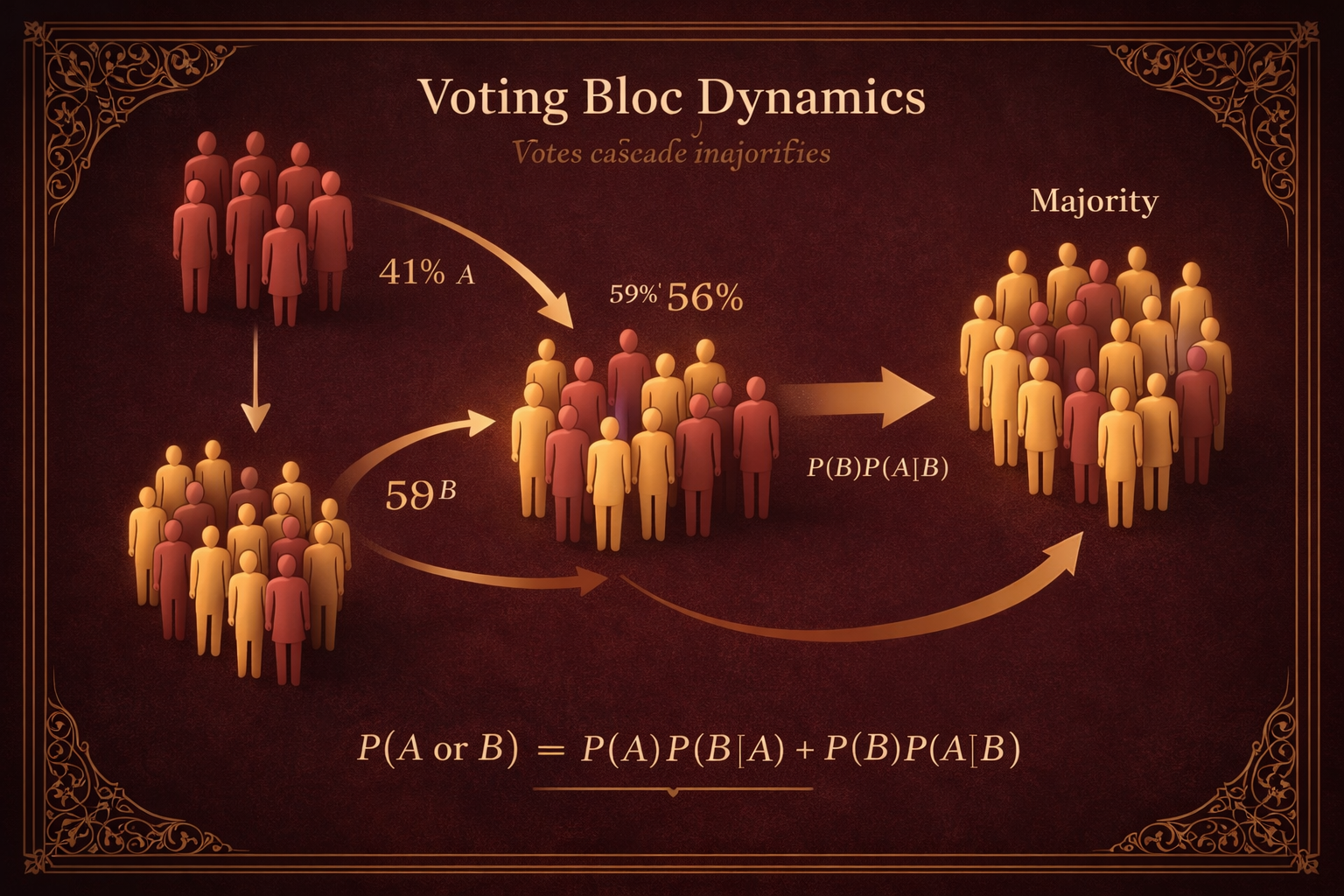
With plurality voting (whoever gets the most votes is banished), the mathematics of coalition formation becomes critical.

Voting patterns reveal hidden alliances - the mathematics of coalition detection
The 85% Rule
Our simulations show that voting patterns are 85% accurate predictors of faction membership. Traitors rarely vote for other Traitors until the late game. If someone voted to banish a confirmed Traitor early, they're very likely Faithful. Voting dynamics are explored in greater depth in the thesis.
Strategic implications:
- For Faithfuls: Track voting patterns obsessively. Who votes together? Who never votes for whom?
- For Traitors: Occasionally vote for fellow Traitors to obscure patterns. The "hero play" (voting out a Traitor) builds massive credibility. Different strategic archetypes handle this differently.
Masking Strain: The Cost of Lying
Perhaps the most fascinating mathematical concept in The Traitors is what I call "masking strain" - the cumulative cognitive and emotional cost of sustained deception.
Deception is hard work. You must:
- Remember what lies you've told - memory systems become critical
- Maintain consistency across conversations - especially challenging across different cultural contexts
- Suppress genuine emotions while projecting false ones - the emotion and deception engine models this
- Monitor others' reactions to your performance
- Adapt in real-time to unexpected challenges
The Strain Formula
Masking Strain = Σ (Duration × Intensity × Complexity) of active deceptions
As strain accumulates, performance degrades. Response times increase. Micro-expressions leak. Verbal tells emerge. Our AI simulations show detectable degradation after 3+ consecutive lies.
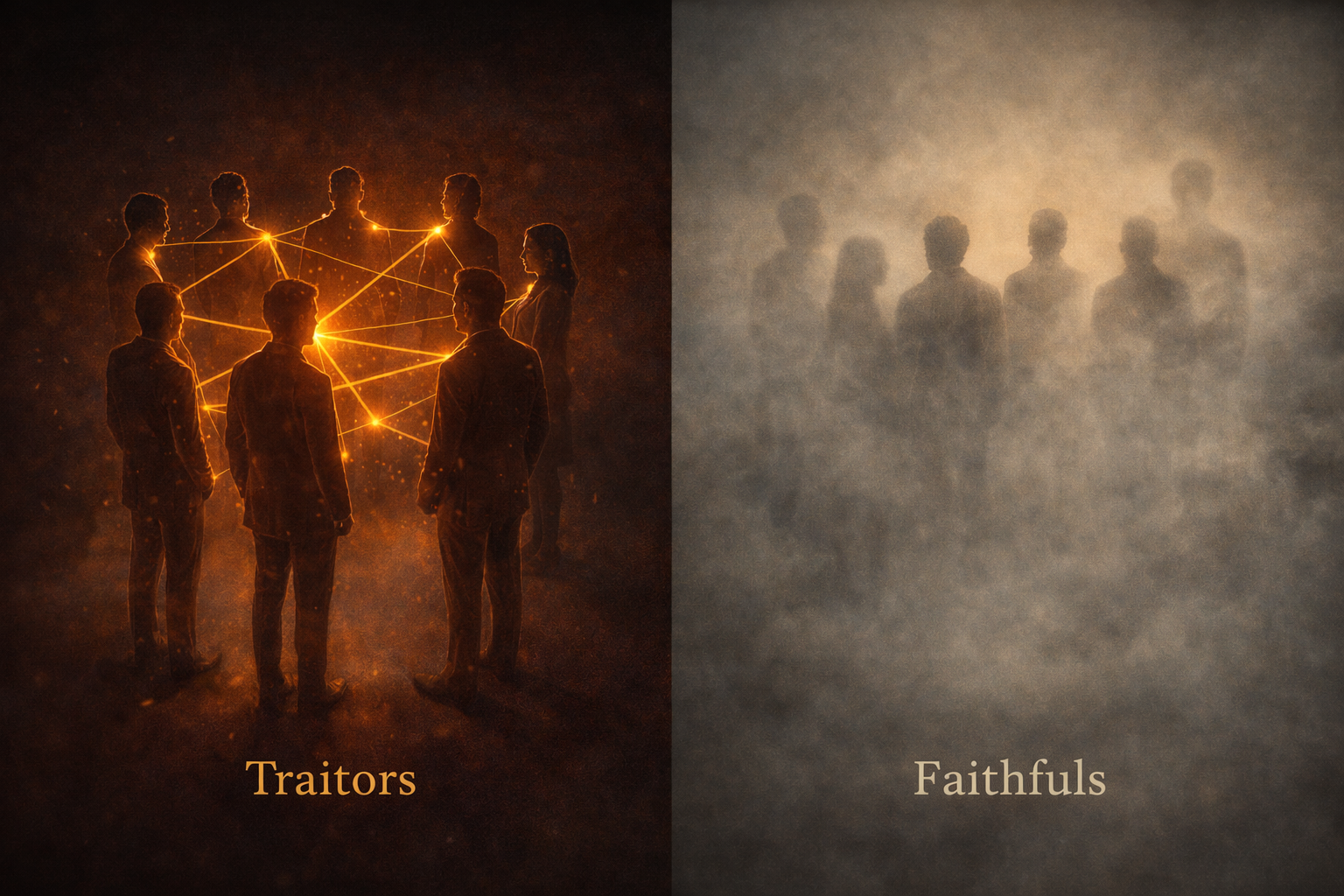
The invisible weight of deception - as lies accumulate, the mask begins to crack
Endgame Mathematics
The endgame introduces a new decision: should surviving players vote to end the game (split prize among remaining Faithfuls) or continue banishing?
The mathematics depend on:
- Probability that remaining Traitors exist
- Number of players remaining
- Expected value of continuing vs. stopping
If you're 70% confident all Traitors are gone with 4 players remaining, ending gives you 25% of the prize (certain). Continuing risks losing everything if a Traitor remains. The expected value calculation often favours ending earlier than intuition suggests.
Key Takeaways
- Bayesian reasoning helps formalise how evidence should shift beliefs
- Information cascades can sweep up innocent players - beware bandwagons. This becomes even more complex with hidden fourth Traitors
- Voting patterns are the most reliable evidence (85% accuracy)
- Deception has measurable costs that accumulate over time
- Endgame decisions require careful expected value calculations. Future format variations may alter these dynamics